

Benchmark ADA Title II Compliance: The Must-Have WCAG Checklist

Interactive guide
The clock is ticking for state and local governments to comply with a new rule under Title II of the Americans with Disabilities Act (ADA). Are you prepared? Get all the information you need about the compliance standard and check how your digital experiences measure up.
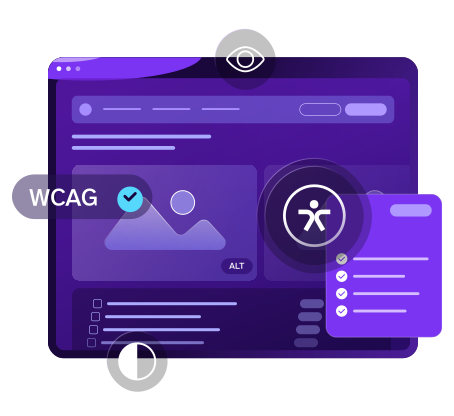
Get clarity on the ADA Title II compliance standard
ADA Title II compliance starts with meeting the Web Content Accessibility Guidelines (WCAG). Download our complete WCAG checklist to:
- Understand all WCAG 2.1 and 2.2 success criteria.
- Get tips and tools to evaluate conformance across websites, apps, and documents.
- Discover best practices for continuous compliance.
The rundown on the new Title II requirements
A 2024 rule from the U.S. Department of Justice (DOJ) sets clear digital accessibility requirements for U.S. state and local governments under ADA Title II. Specifically, organizations must ensure their web and mobile content conforms with WCAG version 2.1 Level A and AA.
Compliance deadlines are approaching fast:
- April 24, 2026: Organizations with a population size of 50,000 or more
- April 26, 2027: Organizations with a population of less than 50,000 and special districts
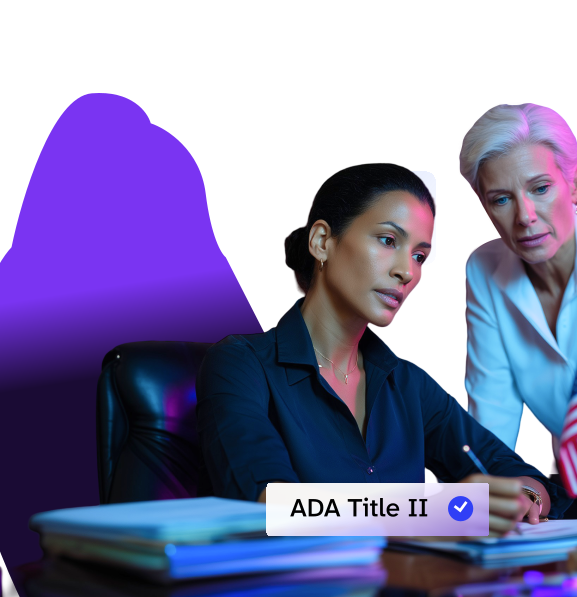
WCAG: The standard for Title II compliance
WCAG is the global standard for making digital content usable for people with disabilities. It outlines technical criteria that help authors, designers, and developers identify, avoid, and fix barriers that people with disabilities may encounter online.
WCAG conformance doesn’t just help you mitigate risk—it ensures your digital services are available to everyone.
Using this checklist: Testing for Title II compliance
To understand whether your digital experiences are compliant with ADA Title II, you’ll need to evaluate them against the WCAG 2.1 Level A and AA criteria in our checklist. Reliable accessibility testing combines two different methods:
Automated testing
Automated tools can quickly identify common accessibility issues—but they cannot yet detect all accessibility barriers or test all types of digital experiences.
Manual and functional testing
In this process, accessibility experts—including people with disabilities—evaluate core pages, components, and key user flows using assistive technology, providing deeper insight than automated tools alone.
Expert perspective: Preparing for April 2026
Are you really ready for April? Tune into our on-demand webinar with disability rights attorney Eve Hill, Partner at Brown, Goldstein, & Levy, for deeper insight on the new ADA Title II requirements and the outlook for enforcement—plus an actionable roadmap you can use to prepare for the deadline.

Achieve ADA Title II compliance with confidence
With the April 2026 deadline rapidly approaching, our State of Digital Accessibility Report found that most organizations still feel exposed to risk. Are you one of them? Explore our WCAG checklist to prepare with clarity and confidence.
More resources for state and local governments
Frequently asked questions
What is ADA Title II, and who must comply?
ADA Title II requires state and local governments to ensure that all programs, services, and activities are accessible to people with disabilities. The DOJ’s 2024 final rule clarifies and updates these obligations for digital environments.
What did the DOJ’s 2024 final rule change?
For the first time, the DOJ formally adopted a technical accessibility standard for digital content under ADA Title II. This rule makes WCAG 2.1 Level AA the binding requirement for public-sector websites, mobile apps, and digital documents. It also defines what types of content are covered, provides compliance timelines, and outlines specific exceptions.
What kinds of digital content are covered by the new rule?
Covered content includes:
- Websites and web applications.
- Mobile applications.
- Digital documents (including PDFs).
- Any digital service used to deliver public programs, services, or activities.
The rule explicitly includes content delivered through third-party vendors or contractors.
Are there any exceptions to the rule?
Yes. The DOJ’s final rule includes specific exceptions, such as:
- Archived web content not currently used.
- Pre-existing conventional electronic documents.
- Certain third‑party content.
- Password‑protected individualized documents.
- Pre‑existing social media posts.
Ship inclusive products faster with Level Access
Accessibility is more than a compliance box to check for developers—it’s integral to building competitive products. Contact our team today to learn how we can help your team create accessible, high-performing digital experiences that drive measurable results.