

The State of Digital Accessibility in Financial Services
In financial services, digital accessibility is both a compliance requirement and a competitive differentiator. Legal pressure remains high for consumer banks under the Americans with Disabilities Act (ADA), European Accessibility Act (EAA), and other laws. Meanwhile, in business-to-business (B2B) fintech, accessibility has quickly become a baseline requirement for procurement.
But ensuring accessible, secure, and seamless experiences across every customer touchpoint can be complex. So, how are financial services organizations approaching digital accessibility today? What actions are driving progress—and what obstacles still stand in the way?
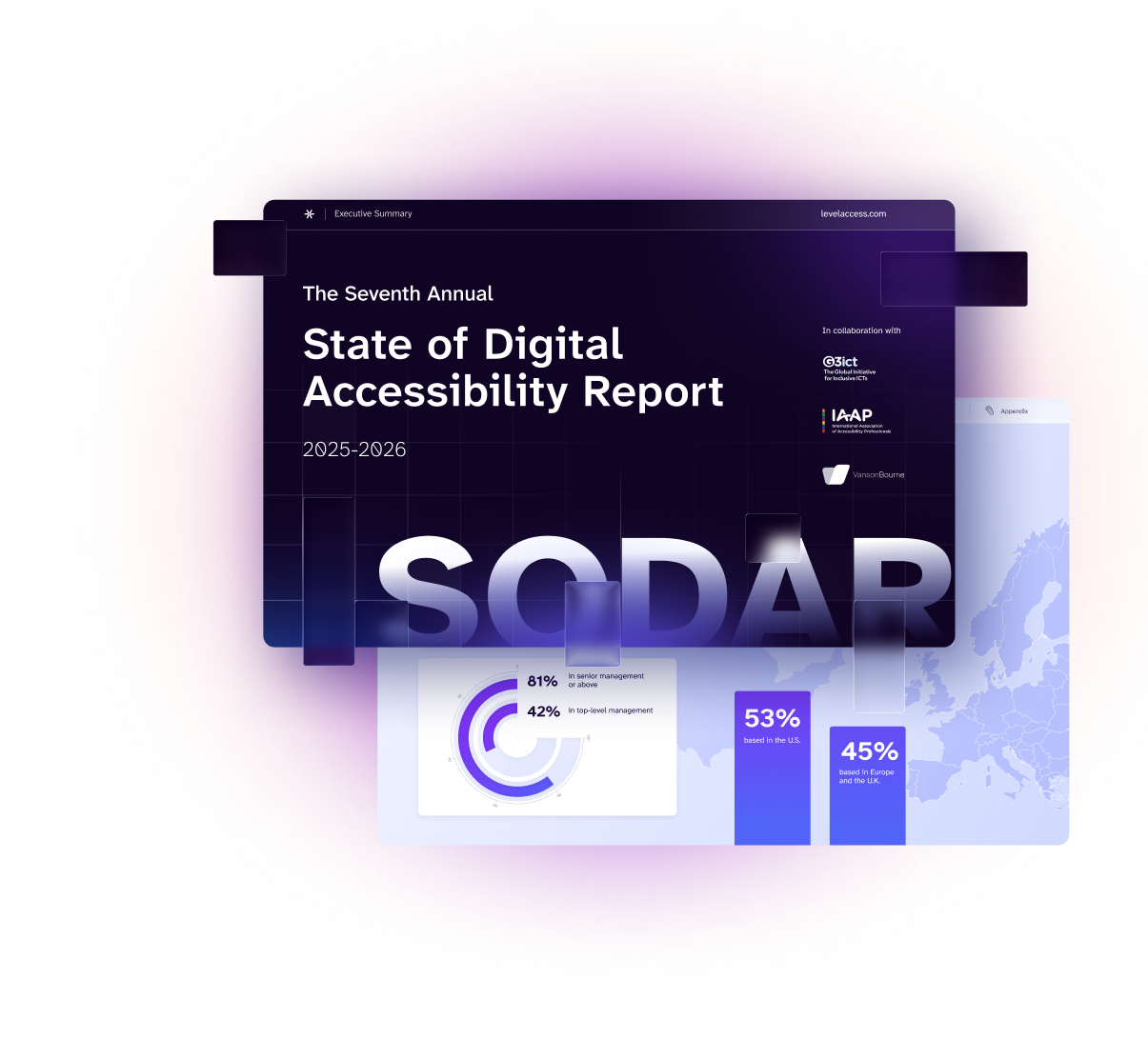
To inform our Seventh Annual State of Digital Accessibility Report, we surveyed financial services leaders across the U.S. and Europe to better understand their practices. This page highlights key insights from our research.
Streamlined digital journeys, stronger business performance
Digital accessibility elevates customer experience—and business’ bottom lines.
Financial services leaders overwhelmingly agree that accessibility contributes to better user experience and business performance. From improving customer acquisition to supporting retention, accessibility plays a critical role across the customer life cycle—boosting bottom-line revenue.
-
94%
of financial services professionals say digital accessibility helps improve user experience.
-
89%
of financial services professionals say it helps improve customer retention.
-
88%
of financial services professionals say it helps improve customer acquisition.
-
85%
of financial services professionals say it helps improve revenue.
Expanding impact and increasing efficiency
Financial services teams are looking to scale organization-wide accessibility.
Financial services providers manage large and diverse digital portfolios—and they’re focused on ensuring every experience is barrier-free.
Accomplishing this is an organization-wide effort, so it’s no surprise that leaders are looking to expand accessibility practices across teams. AI adoption and proactivity, two other top priorities, can also help providers navigate compliance at scale by empowering teams to do more with fewer resources.
-
45%
of financial services professionals say “ensuring accessibility across all digital asset types” is one of the top three priorities for their program.
-
44%
of financial services professionals say “using AI to automate and scale accessibility” is a top priority.
-
39%
of financial services professionals say “approaching accessibility more proactively when creating new digital experiences” is a top priority.
-
39%
of financial services professionals say “increasing adoption of accessibility practices across the organization” is a top priority.
What’s holding financial services teams back—and how to move forward
Competing priorities and limited resources pose barriers to progress.
Financial services leaders recognize the business value of accessibility, and they’re eager to expand their programs. Multiple factors lead to low adoption rates—in particular, our research suggests that conflicting demands, limited capacity, and gaps in tools and services make it difficult for many organizations to maintain momentum.
To advocate for accessibility as a priority—and secure the resources required for sustainable success—program leaders need to clearly communicate the impact of their efforts to executive stakeholders. Reporting tools, like those in the Level Access Platform, equip accessibility champions with data they can use to demonstrate and benchmark progress and ROI.
39%
rank “competing organizational priorities” among the top three challenges facing their digital accessibility program.
34%
cite “insufficient time to address accessibility issues” as a top challenge.
31%
cite “inadequate tools and services for addressing digital accessibility” as a top challenge.
Compliance risks persist across financial services.
What happens if financial services leaders ignore accessibility? Beyond compromising customer experience, digital accessibility gaps continue to put financial services organizations at legal and regulatory risk: the sector remains a common target for ADA lawsuits and demand letters, and EAA enforcement is now underway in Europe.
If your organization is unsure about its legal obligations—or how to meet them—it’s wise to consult with an expert on digital accessibility laws. Our team can provide clarity on what laws and regulations apply to your organization and how to achieve compliance with relevant requirements. If you’ve already received a demand letter or lawsuit, we can support you by validating the claims made and helping you craft a strategic response.
55%
of financial services professionals say they were involved in legal action in the past year.
55%
of financial services professionals say they’re at risk in the year ahead.
Teams seek solutions that blend automation and expert guidance.
To move accessibility programs forward, financial services organizations are prioritizing tools and services that streamline testing, reduce manual effort, and bring expertise where it’s needed most.
90%
of financial services professionals say they are incorporating tools with AI capabilities into their accessibility strategies.
30%
rank accessibility consulting services among the top three new accessibility tools or services they would prioritize investing in.
28%
rank developer tools, like SDKs and testing integrations, among the top new accessibility tools or services they would invest in.
Key takeaways for financial services leaders
What does this data mean for your accessibility strategy? Here are key actions financial services leaders can take to reduce risk and expand program impact:
1. Use AI to increase efficiency at scale.
AI-powered tools can streamline issue prioritization, accelerate remediation, and simplify reporting—helping teams achieve compliance faster and with fewer resources, even when managing accessibility across hundreds or thousands of assets.
2. Shift accessibility earlier in the experience creation process.
Proactively embedding accessibility into design and development reduces rework, speeds up releases, and prevents costly last-minute fixes.
3. Strengthen organization-wide adoption through education.
Practical, role-specific accessibility training helps every team—from product to compliance—contribute to the delivery of inclusive experiences, increasing the efficiency and sustainability of accessibility efforts.
4. Make the business case with data.
Use reporting tools to quantify and communicate your program’s impact. Regularly updating stakeholders on accessibility progress can help you secure executive buy-in and long-term investment.
Provide barrier-free customer experiences with a trusted partner.
To keep pace with rising customer expectations and evolving compliance standards, financial services organizations need a solution that combines intelligent tools with expert support.
Level Access delivers that solution through our Hybrid Intelligence model, which brings together a unified platform with AI agents and human expertise—streamlining accessibility across every digital touchpoint.
Connect with us to learn how we can help you deliver inclusive, compliant, and high-performing digital experiences.